Imagine being told, without anyone saying it directly, that your career depends on the decision you are about to make. That if you go one way, you keep everything. If you go the other way, you lose it all. Most people would pause. Most would weigh the options carefully. A rare few would not pause at all.
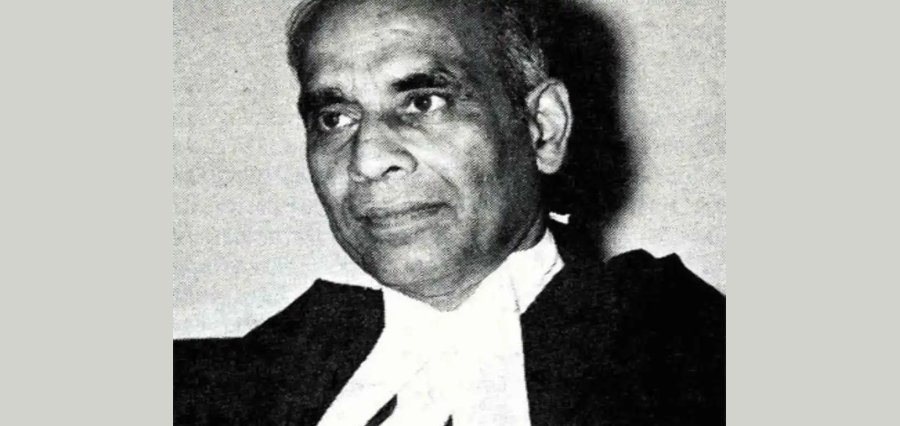
Hans Raj Khanna was one of those rare few. A judge of the Supreme Court of India, he faced exactly that choice in 1976. He chose his conscience over his career. And in doing so, he left behind words and judgments that legal minds around the world still turn to today.
This blog talks about a few of the most powerful H.R. Khanna quotes, and the turns in his life that shaped them, also why they still count far beyond just the courtroom.
A Man of Simple Habits and Unshakeable Beliefs
Born on 3 July 1912 in Amritsar, Hans Raj Khanna started his legal work with discipline and quiet determination. He joined the Supreme Court of India in 1971. Those who knew him described him as humble, principled, and deeply committed to the law.
Justice H.R. Khanna was also a prolific writer. He authored several books, including his autobiography Neither Roses Nor Thorns, Making of India’s Constitution, Judicial Review or Confrontation, and Society and the Law. These were not books written for recognition. They were written because he believed the law belonged to the people and that people deserved to understand it.
The Night Before Everything Changed
In 1975, the Indian government declared a national Emergency. Civil liberties were suspended. Political opponents were jailed. In 1976, five Supreme Court judges were asked one question: could the government imprison citizens and strip them of the right to life, with no recourse to the courts?
Four judges ruled in favour of the government. Justice H.R. Khanna did not.
The night before delivering his dissent, he told his sister, “I have prepared my judgment, which is going to cost me the Chief Justiceship of India.” He was not being dramatic. He knew exactly what was coming. When the time came to appoint the next Chief Justice, the government passed him over. He resigned shortly after.
Among all H.R. Khanna quotes, this one is perhaps the most personal. It was not written for a courtroom or a textbook. It was said quietly, to family, the night before he changed history. It tells you everything about the man.
What He Believed About Freedom
His dissenting judgment in the ADM Jabalpur case contained some of the most powerful H.R. Khanna quotes ever recorded in Indian legal history. He wrote, “The rule of law is the antithesis of arbitrariness in all civilized societies. It has come to be regarded as a mark of a free society.”
In plain terms, this means no government should be able to act without rules or accountability. What protects ordinary people is not the goodwill of those in power. It is the law, applied equally to everyone.
This quote is among the H.R. Khanna quotes most frequently cited in legal arguments and judicial speeches around the world. Written in a specific moment in Indian history, its truth is universal.
A Right That Cannot Be Claimed Is Not a Right at All
In the same dissent, Justice H.R. Khanna argued that the government could not suspend a fundamental right in a way that effectively destroyed it. He held that “the suspension of the right to enforce Article 21 could not have a greater effect than the repeal of Article 21.”
Article 21 of the Indian Constitution guarantees every person the right to life and personal liberty. His position was straightforward: telling someone they have a right but cannot use or enforce it is the same as taking it away entirely.
Decades later, the Supreme Court of India formally upheld this position in the 2017 K.S. Puttaswamy judgment on the right to privacy. The court cited his dissent directly. H.R. Khanna quotes from 1976 shaped a landmark 21st-century ruling. That is the measure of how far ahead of his time he truly was.
On the Duty of Courts
At a dinner held to mark his retirement, Justice H.R. Khanna said something that has stayed with the legal community ever since. He said that courts must earn reverence through the test of truth.
It is a short statement. But it carries real weight. He was not saying courts deserve automatic respect. He was saying that respect has to be earned through honest decisions and the willingness to say difficult things even under pressure.
His own career was the clearest proof of this belief. Among H.R. Khanna quotes on the role of the judiciary, this one speaks most directly to people outside the legal world. Institutions are only as trustworthy as the decisions the people within them are willing to make.
A Legacy That Outlived the Man
Justice H.R. Khanna passed away in February 2008 at the age of 95. He was awarded the Padma Vibhushan in 2002. A portrait of him hangs in Courtroom No. 1 of the Supreme Court of India. His nephew Sanjiv Khanna served as the 51st Chief Justice of India in 2024, carrying the family’s legal legacy forward.
His books remain in print. H.R. Khanna quotes still keep making their way into courtrooms, classrooms, and legal debates across the world. His dissent remains one of the most studied judicial opinions in Indian legal history.
Conclusion: One Voice, and Why It Still Echoes
Not every person who changes history does so loudly. Some do it by simply refusing to move when everything around them is moving in the wrong direction. H.R. Khanna quotes endure not because they are complicated, but because they are honest. They were written by a man who believed the law existed to protect people, and that no political pressure was worth more than that belief. Justice H.R. Khanna’s words remain as relevant today as they were when first uttered, for anyone who studies law, practices law or even just believes in fairness.