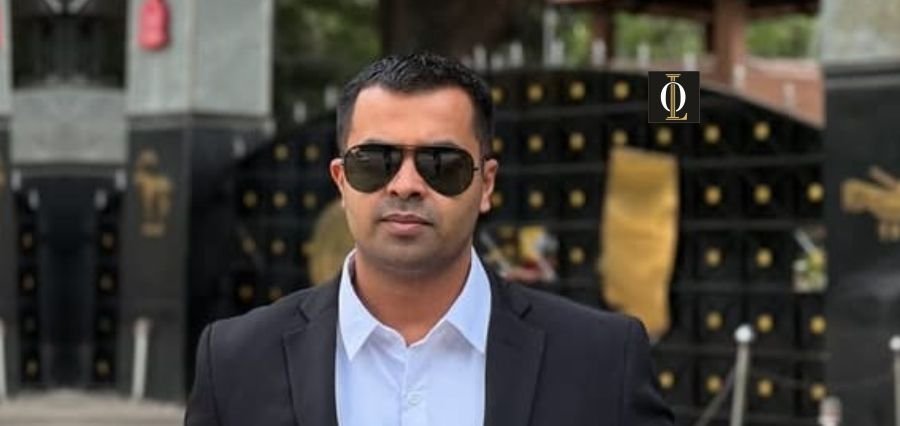
The Formative Journey: From JAG Officer to Supreme Court Advocate
Major Kavish Aggarwala is a practicing lawyer in the Hon’ble Supreme Court, Delhi High Court, and Armed Forces Tribunal, but his work is defined by a mission that began long before he entered the courtroom. The philosophy that drives him is best captured in his poem, “I, The Unsung,” which serves as the mission statement for his life’s work. He wrote it to give voice to the silent, anonymous sacrifice that is the true hallmark of an Indian soldier the “untold thousands” who serve and sacrifice in obscurity. This commitment to the “unsung” is the driving force behind his transition from a military officer to an Advocate.
Prior to his legal practice, Major Aggarwala had an illustrious 11-year career as a Judge Advocate General (JAG) officer in the Indian Army, where he was steadfast in upholding justice and served in the Rashtriya Rifles (RR) in Kashmir. As a JAG officer, he handled all kinds of legal issues, from court-martials and official complaints to deeply personal matters like marital discord. It was during this time that he witnessed firsthand how obviously unfair policies and the high-handedness of authorities caused officers and soldiers to suffer.
These were the “unsung” he sought to defend. After voluntarily taking release from the Army, he began a new chapter of service. His courtroom became his new forward post, his legal briefs his new weapons. He now deals with service matters, property cases, and matrimonial cases, with his primary mission remaining the same: to give a voice to those he represents. He has led more than 1,000 Short Service Commissioned Officers (SSCOs) in their fight for equality and pension benefits, viewing them as the “unsung” who served for years without recognition or post-retirement security. His dedication extends to all vulnerable members of society. In a heartwarming example, Maj Kavish Aggarwala took up pro bono representation for an 11-month-old girl with a life-threatening disease, Spinal Muscular Atrophy (SMA-1). His plea before the Supreme Court led to the government’s intervention and financial assistance, ensuring the child’s treatment and survival. He also remains vigilant in raising funds for the families of martyrs who have sacrificed their lives for the nation. For Major Aggarwala, the pledge he took as an officer did not end when he took off his uniform; it simply transformed. His work today is a continuation of that pledge, aimed at ensuring the voices of the unsung are heard, their rights are protected, and their sacrifices are honored, not just with words and poems, but with tangible justice.
The Journey Begins: A Passion For Law
My passion for law stems from personal life experiences and a deep-seated allergy to injustice that I have had since childhood. Observing the daily struggles and injustices meted out to people, especially the marginalized who lack access to resources, I learned how difficult it is for a common person to get a fair deal from the system and realized the profound importance of sensitivity in judicial decisions.
This passion deepened exponentially when I joined the Indian Army’s Judge Advocate General’s (JAG) department. My move to the Supreme Court after 11 years in uniform was not a pre-planned career transition, but rather a continuation of my service and a calling. As a JAG officer, you are the legal conscience of the command, intimately involved in the raw, unfiltered reality of soldiers’ lives handling everything from court-martials and disciplinary actions to promotion issues and personal matters. This frontline view exposed me not only to immense sacrifice and courage but also to systemic friction, administrative hurdles, and instances where the system fails its own.
Over the decade, I encountered the nuances of military law and came across various organizational policies, many with origins in the colonial era, that are redundant and unfit for a modern military structure. I saw patterns of injustice emerge, particularly the plight of Short Service Commissioned Officers (SSCOs), especially fellow JAG officers. This realization solidified into a conviction: while I could ensure procedural fairness within my role, some of the most profound issues were rooted in policies and laws that required advocacy at the highest levels of the judiciary. Therefore, after taking voluntary retirement, I began practicing before the Supreme Court, various High Courts, and the Armed Forces Tribunals (AFTs). This was a direct evolution of my duty, allowing me to fight for the rights of SSCOs, MNS officers and other defence and paramilitary forces personnel. The strength to stand for those who served the nation comes from my passion for the law and a firm belief in the Rule of Law. I did not leave the Army behind; I simply changed my uniform for a lawyer’s robe to continue serving the men and women who wear it. It remains the same mission, just in a different arena.
The Birth of Law Chambers of Maj Kavish Aggarwala: Breaking New Ground
Community engagement and pro bono work are not mere add-ons to my legal practice; they form its core philosophy. My military background, with its ethos of “service before self,” deeply informs my belief that a lawyer’s duty extends beyond the courtroom. We are custodians of justice, compelled to use our skills for those who are most vulnerable, regardless of their ability to pay. I carry that ethos with me, and my law chambers are built on these values of integrity and service.
After taking voluntary retirement from the Indian Army, I noticed the injustice caused to service personnel by ambiguous and arbitrary government policies. This motivated me to build my own law chamber with the primary aim of providing a voice to armed forces personnel, both serving and retired. We represent them before the Supreme Court, High Courts, the Armed Forces Tribunal, and other forums. While our focus began with service personnel in the Armed Forces and Paramilitary Forces, our clientele is not limited to them, and we deal with all sorts of cases.
I consider myself blessed to have a large team of bright young lawyers to work with, and it would be unfair to take the entire credit for our work. Motivated by a shared vision, the lawyers at my chambers take great pride in providing top-notch legal services. This commitment is directly expressed through our pro bono work. The Chamber is regularly involved in pursuing pro-bono cases and contesting Public Interest Litigations on behalf of marginalized communities and the downtrodden sections of society.
A poignant example is the case of baby Jaishvi, a child with Spinal Muscular Atrophy (SMA), where we leveraged our platform to bring attention to a critical human issue. It was a reminder that the law must have a human face and a compassionate heart, and that sometimes the most important battles are fought for a child’s right to life and health.
This work is vital because it keeps me grounded in the fundamental reason I entered this profession: to be an advocate for justice in its purest form. Whether fighting for a soldier’s pension or helping a family in desperate need, the principle is the same standing up for those facing overwhelming odds. It reinforces my belief that the true measure of success is not in personal victories, but in the difference, we make in the lives of others. It is my way of continuing to serve.
A Broad Spectrum Of Practice Areas
We at the Law Chambers of Maj Kavish Aggarwala primarily handle Writ Petitions, Public Interest Litigations, Transfer Petitions, and Appellate matters before the Supreme Court of India, several High Courts across the Country, and all the Tribunals and Apex Commissions viz. Armed Forces Tribunal (AFT), Central Administrative Tribunal (CAT), National Green Tribunal (NGT), National Consumer Disputes Redressal Commission (NCDRC), National Company Law Tribunal (NCLT), National Company Law Appellate Tribunal (NCLAT), Debt Recovery Tribunal (DRT) and Debt Recovery Appellate Tribunal (DRAT). We also handle Trial matters before the District Courts, Real Estate Regulatory Authority (RERA), Consumer Forums and Commissions, and Arbitral Tribunals situated in Delhi.
Driving Principles Of Success
As far as the driving principles of success are concerned, unhesitatingly, I would say that a lawyer must be driven by the following principles to be successful
- Compassion;
- Ability to Listen;
- Assertiveness, not Aggressiveness;
- Creativity in Complex Cases;
- Perseverance;
However, for me, the smile on the client’s face and the satisfaction after receiving a favourable order are the motivation as well as the driving principle behind success.
Advice For Aspiring Lawyers
HMJ S. Mohan once observed in his judgment that “Advocacy is not a craft but a calling; a profession wherein devotion to duty constitutes the hallmark. The sincerity of performance and the earnestness of endeavour are the two wings that will bear aloft the advocate to the tower of success. Given these virtues, other qualifications will follow of their own account. This is the reason why the legal profession is regarded as a noble one.”
In the initial years of practice, every lawyer should endeavour to experience everything and, on the basis of the experience accumulated, must decide the path that suits him/her. It is true that we are living in the era of specialization; therefore, all young lawyers must focus on the areas in which recruiters will have interest. The idea is to say that the young law student should be an asset, not a liability, for the recruiter.
Therefore, initially, broad-based internships and work (which translates into a broad understanding of first principles of law and broader lay of the land), which slowly gravitate to the subject area work, really well for me personally.
As one masters any field, he/she become the knowledge base of the firm or the ‘go to person’ on that subject, and people approach him/her for any consultation on the subject matter. It develops your credibility and reputation as a lawyer, not only in the firm but also generically in terms of clients & all who start trusting you.
Also, simplicity is very crucial, so the idea is to write something easily comprehendible, witty, and interesting. I believe, if you can’t state it simply enough, you haven’t understood it well enough. And, if you can’t say out loud what you’ve written, don’t write it either. It has paid great dividends to me as well.
Law cannot be studied in a vacuum, so if the candidate is well read on economics, sociology, etc gives them upper edge. To have better dialogue and conversation with judges or clients, policy makers, and business leaders, you need to have a worldview, and being well-read definitely helps. Someone said the difference who read and those who don’t read is between a mason and an architect.
It should also be borne in mind that the best advocates of all generations have been devotees of honesty. Abraham Lincoln found his fame and success in the profession on what some called his ” perverse honesty”. So, it is advised to young Lawyers that they should be brutally honest with the Judge/Court because an Advocate is not only the client’s servant but also the Court’s friend, and honesty is as essential to true friendship as it is to sound advocacy.
Client-Centric Approach: A Commitment To Excellence
At the Law Chambers of Maj Kavish Aggarwala, our foremost endeavour is to empower our clients and help them reshape their lives through effective legal guidance. We are committed to breaking barriers, setting higher benchmarks, and delivering exceptional legal services with unwavering attention to precision and client satisfaction. Guided by our core values such as Integrity, Industry, and Ingenuity, we relentlessly strive to craft innovative, result-oriented solutions while upholding the highest standards of professionalism and trust.
At the Law Chambers of Maj Kavish Aggarwala, our commitment goes beyond investing in our clients; it lies in embodying a mindset that blends integrity, intellect, energy, and strategic vision. This distinctive character forms the very backbone of our chamber and defines who we are. It is this unwavering ethos that empowers us to stand as our clients’ guiding star and trusted legal advisor, consistently delivering counsel they can rely on with confidence.
The entire profession is based on knowledge assyemtry; knowing or understanding something that the opposite side doesn’t and thriving on that. We should not sell anything except what we know and how we think. It is very important to mention here that addressing the problems of the client and working in his/her best interest as an advocate holds paramount importance in winning the trust of the client.
For instance, we keep updating our clients about the status of the case at every stage.
We create WhatsApp groups with a view to facilitating drafting and other work related to the case. My team of brilliant Advocates swiftly addresses the queries or doubts of the Clients in the group itself. In my opinion, we should not keep anyone or anything under the sun, as it is the right of the client to know about the status of his/her case, and I think ‘Trust’ is the only constant to maintain the sanctity of the relationship between a Client and the Attorney.
Shaping The Future Of Legal Practice
As an Ex-JAG officer of the Indian Army, I perceive the future of legal practice through the lens of discipline, honour, and service to justice. The legal fraternity today stands at the confluence of enduring tradition and unprecedented transformation.
While the essence of advocacy will always rest upon integrity, rigour, and fidelity to the rule of law, the profession must now march forward with strategic foresight embracing innovation, technology, and reform without surrendering its moral compass. The chambers of the future will be defined not merely by eloquence in argument, but by efficiency, preparedness, and ethical precision, much like a command post guided by clarity of purpose and unity of mission.
In my vision, the legal profession must evolve as a force multiplier for justice, blending the discipline of the armed forces with the intellect of the bar. The modern advocate must not only interpret the law but also inspire faith in it; not merely fight for clients, but stand as custodians of fairness and constitutional morality.
The Road Ahead: A Future Of Legal Innovation
As the legal landscape advances toward greater innovation, it becomes imperative to ensure that reform reaches even the most insulated corners of the justice system, including the military justice framework.
It is paradoxical that, in an age of digital transformation, court martial proceedings still prohibit the use of devices, digital documentation, or electronic evidence management, practices that have long become standard in civilian courts. This technological vacuum not only delays justice but often obscures its visibility. The future must therefore embrace digitized records, secure video trials, and evidence management systems, while maintaining the sanctity of military discipline.
ADR mechanism: a savior in tackling the backlogs of cases
India has almost 4.57 crore pending cases, many of which have been delayed over 10 years, causing injustice to the litigants. It is being said that justice delayed is justice denied. So, Alternative Dispute Resolution (ADR) is surely a saviour in tackling the backlog of cases. It is a more efficient method of resolving dispute which is why people are slowly turning away from the traditional civil processes/suits.
An Advocate’s Vision Of A Civil Society
Lawyers have always played a vital role in society, serving as advocates for justice, protectors of rights, and interpreters of the law. As an officer of the Court and a privileged member of the community, an advocate has a great responsibility to uphold the pillars of a true civil society: justice, equality, fraternity, and accountability. My vision is for a nation where Constitutional values and the Rule of Law prevail over influence, where rights are not privileges, and where every individual, regardless of status, stands equal before the law. The strength of our nation lies not merely in its laws but in their fair and fearless implementation.
An advocate’s role extends beyond the courtroom; it encompasses the responsibility to educate, empower, and inspire respect for the legal system. While winning cases is the immediate, tangible goal, my hope is for a legacy that transcends individual court victories. I want to be remembered as someone who helped foster a fundamental shift in the national consciousness a move from performative patriotism to substantive support for our armed forces personnel.
My goal is to help institutionalize fairness within the military system. Winning cases is not just about securing benefits for the petitioners; it is about setting a precedent that ensures future generations of officers are treated with the dignity they deserve and forcing policy changes that recognize the true value of their service. Similarly, advocating for reforms in the disability pension system is about creating a more compassionate and just process for all veterans.
I also hope to pioneer a new path for veteran engagement, showing that a post-service career can be one of “Advocacy as Continued Service.” Veterans possess an unparalleled understanding of the military’s strengths and weaknesses, and I hope more will leverage this unique expertise to become agents of constructive change. This is why I am committed to our internship program to mentor the next generation of lawyers specializing in the crucial intersection of military and constitutional law.
Ultimately, I hope my legacy is one of empowerment: empowering soldiers to know and fight for their rights and empowering the public to look beyond the uniform and offer unwavering support every day. My vision is of a civil society where justice is not demanded through protest but delivered through process, and where the law is a shield for the vulnerable. If my work can contribute to a system where the nation’s promise to its defenders is always kept.